


Digital applications and process automation
Intelligent automation connects document handling, data, rules, and approvals into one seamless process. It doesn't just address individual steps (like extraction or transcription) but the entire workflow from input to result—including exceptions, responsibilities, deadlines, and oversight. It provides the greatest value in areas with high volumes of routine tasks, frequent exceptions, and multiple systems where processes currently rely on manual forwarding, retyping, and tracking.
Saving capacity and time
Automation takes over routine tasks across systems. Incoming data and documents are captured, sorted, and pre-filled according to set rules, allowing your team to focus on exceptions and decision-making.
Fewer errors and complaints
Validation and rules catch common discrepancies—such as missing information, duplicates, or system mismatches—before anything is sent further.
Seamless process flow
The workflow automatically assigns tasks to the right people, monitors dependencies and deadlines, escalates when necessary, and ensures no request ever gets lost in an email inbox.
Quick adjustments without complex development
Have conditions changed? Approval rules or roles? In a low-code environment, you can adjust settings without writing code. This ensures your process keeps pace with operational reality—not IT capacity availability.
From automation to building applications
Using an AI-augmented low-code platform, we don't just solve individual workflow automation; we build entire digital applications that replace fragmented spreadsheets, emails, and legacy systems.
In a single environment, we create:
▪️digital user interfaces (forms, overviews, dashboards),
▪️management of inputs, checks, approvals, and exceptions,
▪️connections to existing systems (DMS, ERP, CRM…),
▪️overviews, reports, and automated actions.
Typical scenarios where we build full applications:
▪️Insurance claims processing
▪️Underwriting and risk scoring
▪️Request registration and internal approval applications
▪️Management of contracts, amendments, and related processes
▪️Client or employee onboarding
▪️Cross-departmental communication automation (e.g., HR–IT–Legal)
Process management without the chaos
Companies often don't lack technology, but rather a cohesive process. Documents arrive through various channels, data is re-entered into multiple systems, exceptions are handled via email, and approvals are opaque, causing the process to easily stall with a single person. The result is unnecessary labor, errors, waiting, and low predictability.
Intelligent automation changes this—it creates a single managed flow where:
▪️inputs are captured, processed, and key data extracted,
▪️checks are performed (mandatory fields, duplicates, reference compliance),
▪️the system creates a task or exception with clear instructions and assignments,
▪️everything is traceable and measurable.
How we solve it at INFOMATIC
We build automation to fit your reality—not a pre-defined template. We start by analyzing the current state: inputs, roles, exceptions, systems, and goals.
We implement the process on the Tungsten TotalAgility platform, which connects:
▪️workflow and task management,
▪️document and data processing,
▪️business logic and rules,
▪️integrations into ERP/DMS/CRM and legacy systems (via API or RPA).
This allows us to build a managed flow that:
▪️handles routine tasks automatically,
▪️enables scaling and adjustments without coding,
▪️remains clear even in complex scenarios.
We use the Tungsten TotalAgility low-code platform to manage the entire process. It integrates workflows, document and data handling, rules, exceptions, and integrations into one managed stream. It also serves as the foundation for building digital application frontends, data models, and business rules. This allows us to quickly set up, test, fine-tune, and gradually expand processes. We supplement TotalAgility with additional components as needed.
The result is a process that is faster, less error-prone, scalable, and transparent: the system automatically handles routine steps, people only address what requires human judgment, and you maintain control over what is happening—across all teams and systems.
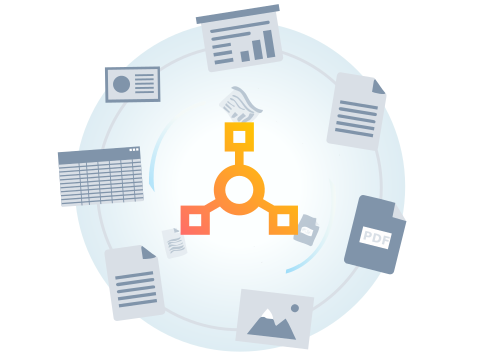
We transform
Turn document chaos into trusted, AI-ready data. Capture, classify, extract, and verify information from incoming documents—eliminating manual data entry, improving straight-through processing, and accelerating downstream decision-making.
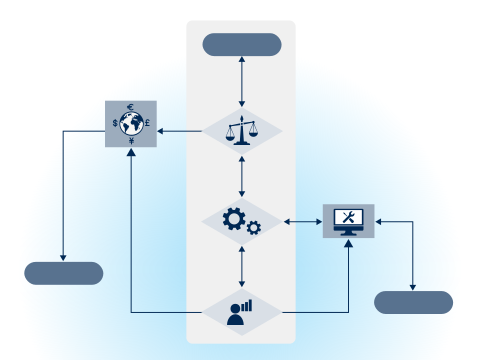
We orchestrate
Automate business processes across systems and teams. Automate end-to-end workflows across systems and teams, coordinating people, processes, and AI agents to eliminate bottlenecks and ensure smooth operations.
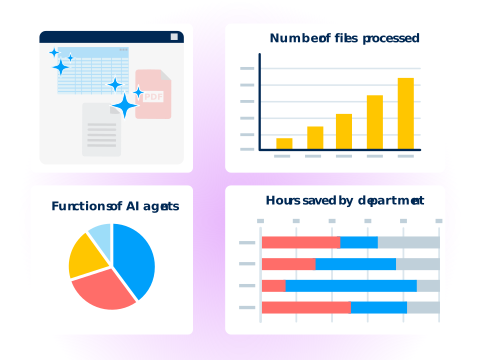
We discover
Gain real-time business insights for more confident decision-making. Uncover insights, patterns, and knowledge hidden in unstructured content for faster, more confident decisions across your entire company.
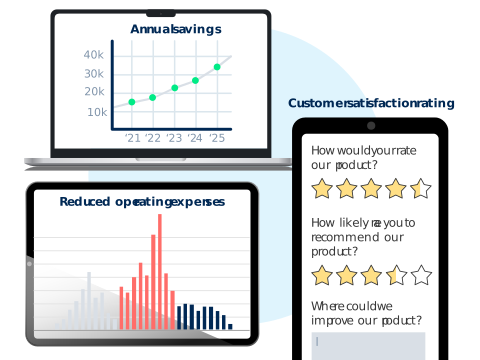
The extra mile
Achieve measurable results at scale. Move from insights to real-world impact with scalable automation that delivers measurable results in complex, document-driven processes across all major industries and use cases.
Our technology
TotalAgility
platform for end-to-end automation
A low-code platform for managing processes across the entire organization. It combines workflows, business rules, document management, and integrations into a single stream—including exception handling and audit trails.
Where do they use our solutions?
Case studies and project results



Frequently Asked Questions
Here you will find answers to the most frequently asked questions regarding intelligent automation.
It is an approach that addresses not just one partial step, but the entire workflow – from input to result.
It combines document and data processing, workflow management, the application of business rules, approvals, and exception handling. Furthermore, it connects to internal systems (e.g., ERP, CRM, DMS) and maintains an audit trail for every action. Unlike standard automation (e.g., data extraction), intelligent automation manages the entire process across teams, roles, and applications – and often also allows for building custom applications without programming.
Mainly those that involve repetitive steps, clear rules, and frequent exceptions. These typically include:
▪️document processing in finance and back office,
▪️HR tasks (e.g., onboarding),
▪️digital mailrooms,
▪️approval workflows,
▪️internal requisitions or requests,
▪️customer inquiries and their resolution.
Automation saves time spent searching for documents, eliminates errors from manual data entry, and increases transparency.
We most often connect to DMS, ERP, and CRM systems. The preferred method is via API; for older or closed systems, we can combine API and RPA to minimize manual work even where direct integration is unavailable.
Yes. Using an AI-augmented low-code platform, we don't just automate individual steps; we build entire business applications tailored to your processes. Typical solutions include:
▪️insurance claim registration,
▪️claims processing or underwriting,
▪️contract and amendment management,
▪️client or employee onboarding,
▪️tracking and approving requests across departments.
Applications combine forms, workflows, business logic, system connections, and dashboards in one environment – without the need for lengthy development.
The advantage is rapid implementation, easy maintenance, and the ability to make changes without coding, often directly by the customer's internal IT team.
Both options are possible. The choice depends on your internal policies, integrations, and operational or management requirements.
Space for another question
Have any questions?
I am here to help
Jiří Plešek
Senior Sales Manager
